rfc2543 -> Obsoleted by: 3261, 3262, 3263, 3264, 3265
rfc3261: SIP: Session Initiation Protocol
Sunday, October 18, 2009


Monday, August 24, 2009
防护等级介绍
● 防护等级介绍
IP是国际用来认定防护等级的代号,IP等级由两个数字所组成,第一个数字表示防尘,第二个数字由表示防水,数字越大表示其防护组合越佳。
防尘等级
号码 防护程度 定义
0 无防护 无特殊的防护
1 防止大于50mm之物体侵入 防止人体因不慎碰到内部零件
2 防止大于12mm之物体侵入 防止手指碰到内部零件
3 防止大于2.5mm之物全侵入 防止工具,电线或限制范围的物体侵入
4 防止大于1.0mm之物体侵入 防止的蚊蝇、昆虫或物体侵入
5 无法完全防止灰尘侵入 侵入灰尘量不会影响灯具正常运作
6 防尘 完全防止灰尘侵入
防水等级
号码 防护程度 定义
0 无防护 无特殊的防护
1 防止滴水侵入 防止垂直滴下之水滴
2 倾斜15度时防止滴水侵入 当物体倾斜15度时,仍可防止滴水
3 防止喷射的水侵入 防止雨水、或垂直入夹角小于50度方向
4 防止飞溅的水侵入 防止各方向飞溅而来的水侵入
5 防止大浪的水侵入 防止大浪或喷水孔急速喷出的水侵入
6 防止大浪的水侵入 在一定时间和水压的条件下仍正常运作
7 防止侵水的水侵入 无期限沉没在一定水压的条件下正常运作
8 防止沉没的影响
IP是国际用来认定防护等级的代号,IP等级由两个数字所组成,第一个数字表示防尘,第二个数字由表示防水,数字越大表示其防护组合越佳。
防尘等级
号码 防护程度 定义
0 无防护 无特殊的防护
1 防止大于50mm之物体侵入 防止人体因不慎碰到内部零件
2 防止大于12mm之物体侵入 防止手指碰到内部零件
3 防止大于2.5mm之物全侵入 防止工具,电线或限制范围的物体侵入
4 防止大于1.0mm之物体侵入 防止的蚊蝇、昆虫或物体侵入
5 无法完全防止灰尘侵入 侵入灰尘量不会影响灯具正常运作
6 防尘 完全防止灰尘侵入
防水等级
号码 防护程度 定义
0 无防护 无特殊的防护
1 防止滴水侵入 防止垂直滴下之水滴
2 倾斜15度时防止滴水侵入 当物体倾斜15度时,仍可防止滴水
3 防止喷射的水侵入 防止雨水、或垂直入夹角小于50度方向
4 防止飞溅的水侵入 防止各方向飞溅而来的水侵入
5 防止大浪的水侵入 防止大浪或喷水孔急速喷出的水侵入
6 防止大浪的水侵入 在一定时间和水压的条件下仍正常运作
7 防止侵水的水侵入 无期限沉没在一定水压的条件下正常运作
8 防止沉没的影响
Thursday, December 25, 2008
Adjust the performance of WinPcap
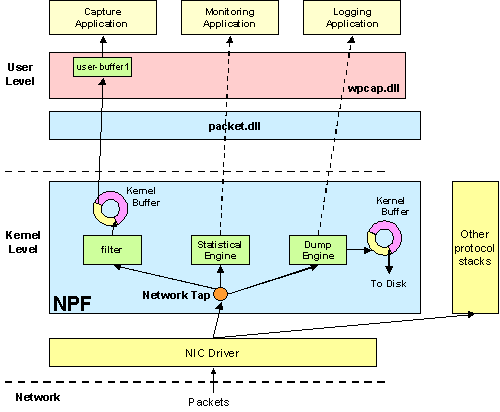
1. WinPcap archtechure

2. Performance related function.
2.1 int pcap_setuserbuffer(pcap_t *p, int size); // set the user-buffer size, in bytes,
2.2 int pcap_setbuff (pcap_t *p, int dim); // set the kernel-buffer size, in bytes
2.3 int pcap_setmintocopy (pcap_t *p, int size);//
2.4 send multi-packages to the kernel at once
pcap_send_queue* pcap_sendqueue_alloc ( u_int memsize );
void pcap_sendqueue_destroy ( pcap_send_queue * queue ) ;
int pcap_sendqueue_queue ( pcap_send_queue * queue, const struct pcap_pkthdr * pkt_header, const u_char * pkt_data );
u_int pcap_sendqueue_transmit ( pcap_t * p, pcap_send_queue * queue, int sync )
2. Performance related function.
2.1 int pcap_setuserbuffer(pcap_t *p, int size); // set the user-buffer size, in bytes,
2.2 int pcap_setbuff (pcap_t *p, int dim); // set the kernel-buffer size, in bytes
2.3 int pcap_setmintocopy (pcap_t *p, int size);//
2.4 send multi-packages to the kernel at once
pcap_send_queue* pcap_sendqueue_alloc ( u_int memsize );
void pcap_sendqueue_destroy ( pcap_send_queue * queue ) ;
int pcap_sendqueue_queue ( pcap_send_queue * queue, const struct pcap_pkthdr * pkt_header, const u_char * pkt_data );
u_int pcap_sendqueue_transmit ( pcap_t * p, pcap_send_queue * queue, int sync )
Monday, November 10, 2008
Some algorithms for RSA
1. Euclid Algorithm: GCD(a, b) = GCD(b, a % b)

  1.1 a fast gcd implimetation:

  1.2 calculate d for equation: (e*d)%( (p-1)(q-1) ) == 1
 e * d = 1 (mod R) // (pre-condition gcd(e, R) = 1)
 ==> e * d = R * k + 1
 ==> e * d - R * k = e * d + R * K = 1 = gcd(e, R)
 ==> R * d1 + (e%R) * K1 = gcd(R, e%R) // (replace: e=>R, R=> e%R)
 ==> e * d + R * K = R * d1 + (e%R) * K1 // ( gcd(e, R) == gcd(R, e%R)
 ==> e * d + R * K = R * d1 + (e - [e/R]*R) * K1 = R * d1 + e * K1 - [e/R]*R * K1 = e * K1 + R * (d1 - [e/R]) * K1
 ==> d = K1, K = d1 - [e/R] * K1


#include < iostream >

bool Euclid(unsigned long& d, unsigned long   e, unsigned long R)
{
    unsigned long   m=R, t1,t2;
    unsigned long   k=1,k1=0;
    d = 0;

    while(e!=1)
    {
        if(e==0)   return false;
        t1=R/e;
        t2=R%e;

        if( d < t1*k ) {
            k1 = (t1*k - d) % m;
            if(k1 > 0) { k1 = m - k1; }
        } else {
            k1 = d - t1*k;
        }
            k1= (d>=t1*k) ? (d - t1*k) : (d + m - t1*k);
        d=k;
        k=k1;

        R=e;
        e=t2;
    }
    d = k;
    return   true;
}
main()
{
    unsigned long   a,b,c;

    std::cout << "Input a:";
    std::cin >> a;
    std::cout << "Input b:";
    std::cin >> b;

    if(Euclid(c, a,b))
        std::cout << "( " << a << " * " << c << ") % " << b  << " == 1 " << std::endl;
    else
        std::cout << "gcd(" << a << ", " << b << ") != 1" << std::endl;
}

2. Prime detect

  Fermat小定理:
    若n是素数,则对所有1≤a≤n-1的整数a,有a^(n-1)mod n=1;
    该定理的逆否命题也成立,即a^(n-1)mod n!=1,则n为合数;
    该定理的逆命题不一定成立, 如当a=4,n=15时,4^14mod15=1,但是4不是素数而是合数。

  如果满足a^(n-1)mod n=1,则n较大概率为素数。我们把那些使得n原本为合数而被看成素数的a叫做伪证据,n为伪素数。

  强伪素数:
    设n是一个大于4的奇整数,s和t是使得(n-1)=(2^s)*t的正整数,其中t为奇数,设B(n)是如下定义的整数集合:
    a属于集合B(n)当且仅当2≤a≤n-2且
      1: a^tmodn=1,或
      2: 存在整数i,0 <= i < s 满足a^((2^i)*t) mod n=n-1

    当n为素数时, 任意a在2和n-1中,均有a属于集合B(n);
    当n为合数时,若a属于集合B(n),则称n为一个以a为底(基)的强伪素数,称a为n素性的强伪证据。
    n为素数,说明它对所有底均为强伪素数

typedef unsigned long T1;
typedef unsigned long long  T2;

bool btest(const T1 a, const T1 n)
{
        if( !(n&0x01) ) return false;  // n is a Odd

        // (n-1)= t*(2^s), t is a odd
        T1 s = 0, t = n-1;
        do {
                ++s;
                t >>= 1;
        } while( !(t&0x01) );

        // a^t mod n = 1
        T2 tmp = 1;
        for(unsigned int i=0; i < t; i++) {
                tmp = (tmp * a) % n;
        }

        if(tmp == 1 || tmp == n - 1) return true;

        //a^((2^i)*t) mod n = n-1
        T1 i = 1;
        for(; i < s; ++i) {
                tmp *= tmp;
                tmp %= n;
                if(tmp == n - 1) return true;
        }

        return false;
}
Wednesday, November 5, 2008
MD5 algorithm C++ implementation
/* md5.c - MD5 Message-Digest Algorithm
* Copyright (C) 1995,1996,1998,1999,2001,2002,
* 2003 Free Software Foundation, Inc.
*
* This file is part of Libgcrypt.
*
* Libgcrypt is free software; you can redistribute it and/or modify
* it under the terms of the GNU Lesser General Public License as
* published by the Free Software Foundation; either version 2.1 of
* the License, or (at your option) any later version.
*
* Libgcrypt is distributed in the hope that it will be useful,
* but WITHOUT ANY WARRANTY; without even the implied warranty of
* MERCHANTABILITY or FITNESS FOR A PARTICULAR PURPOSE. See the
* GNU Lesser General Public License for more details.
*
* You should have received a copy of the GNU Lesser General Public
* License along with this program; if not, write to the Free Software
* Foundation, Inc., 59 Temple Place - Suite 330, Boston, MA 02111-1307, USA
*
* According to the definition of MD5 in RFC 1321 from April 1992.
* NOTE: This is *not* the same file as the one from glibc.
* Written by Ulrich Drepper, 1995.
* heavily modified for GnuPG by Werner Koch
*/
#ifndef _MD5_H_
#define _MD5_H_
#include
#include
#include
#include "CryptoBase.h"
/* Test values:
* "" D4 1D 8C D9 8F 00 B2 04 E9 80 09 98 EC F8 42 7E
* "a" 0C C1 75 B9 C0 F1 B6 A8 31 C3 99 E2 69 77 26 61
* "abc 90 01 50 98 3C D2 4F B0 D6 96 3F 7D 28 E1 7F 72
* "message digest" F9 6B 69 7D 7C B7 93 8D 52 5A 2F 31 AA F1 61 D0
*/
namespace Crypto
{
//#define WORDS_BIGENDIAN
class md5
{
protected:
u32 _A, _B, _C, _D; // chaining variables
u32 _nblocks; // max digest size is limited to 64 * 4G
int _count;
u8 _buf[64];
const u32 rol (const u32 x, const unsigned int n) const { return ( ((x) << (n)) | ((x) >> (32-(n))) ); }
void copy_u32 (u32& dest, const u32 src)
{
#ifdef WORDS_BIGENDIAN
dest = ( ((src&0x000000FF) << 24) | ((src&0x0000FF00) << 8) |
((src&0x00FF0000) >> 8) | ((src&0xFF000000) >> 24) );
#else
dest = src;
#endif
}
/* These are the four functions used in the four steps of the MD5 algorithm
and defined in the RFC 1321. The first function is a little bit optimized
(as found in Colin Plumbs public domain implementation). */
/* #define FF(b, c, d) ((b & c) | (~b & d)) */
const u32 FF(const u32 b, const u32 c, const u32 d) const { return (d ^ (b & (c ^ d))); }
const u32 FG(const u32 b, const u32 c, const u32 d) const { return FF (d, b, c); }
const u32 FH(const u32 b, const u32 c, const u32 d) const { return (b ^ c ^ d); }
const u32 FI(const u32 b, const u32 c, const u32 d) const { return (c ^ (b | ~d)); }
void round1(u32& a, const u32 b, const u32 c, const u32 d, const u32 Xk, const u32 s, const u32 Ti) {
a += FF (b, c, d) + Xk + Ti;
a = rol(a, s);
a += b;
}
void round2(u32& a, const u32 b, const u32 c, const u32 d, const u32 Xk, const u32 s, const u32 Ti) {
a += FG(b, c, d) + Xk + Ti;
a = rol(a, s);
a += b;
}
void round3(u32& a, const u32 b, const u32 c, const u32 d, const u32 Xk, const u32 s, const u32 Ti) {
a += FH(b, c, d) + Xk + Ti;
a = rol(a, s);
a += b;
}
void round4(u32& a, const u32 b, const u32 c, const u32 d, const u32 Xk, const u32 s, const u32 Ti) {
a += FI(b, c, d) + Xk + Ti;
a = rol(a, s);
a += b;
}
/****************
* transform 64 bytes
*/
void transform (const void* const data )
{
u32 A = _A;
u32 B = _B;
u32 C = _C;
u32 D = _D;
#ifdef WORDS_BIGENDIAN
u32 correct_words[16];
const u32 * const src = reinterpret_cast(data);
for(size_t n=0; n<16; n++) {
copy_u32(correct_words[n], src[n]);
}
#else
const u32* const correct_words = reinterpret_cast(data);
#endif
// Before we start, one word about the strange constants.
// They are defined in RFC 1321 as
// T[i] = (int) (4294967296.0 * fabs (sin (i))), i=1..64
round1 (A, B, C, D, correct_words[0], 7, 0xd76aa478);
round1 (D, A, B, C, correct_words[1], 12, 0xe8c7b756);
round1 (C, D, A, B, correct_words[2], 17, 0x242070db);
round1 (B, C, D, A, correct_words[3], 22, 0xc1bdceee);
round1 (A, B, C, D, correct_words[4], 7, 0xf57c0faf);
round1 (D, A, B, C, correct_words[5], 12, 0x4787c62a);
round1 (C, D, A, B, correct_words[6], 17, 0xa8304613);
round1 (B, C, D, A, correct_words[7], 22, 0xfd469501);
round1 (A, B, C, D, correct_words[8], 7, 0x698098d8);
round1 (D, A, B, C, correct_words[9], 12, 0x8b44f7af);
round1 (C, D, A, B, correct_words[10], 17, 0xffff5bb1);
round1 (B, C, D, A, correct_words[11], 22, 0x895cd7be);
round1 (A, B, C, D, correct_words[12], 7, 0x6b901122);
round1 (D, A, B, C, correct_words[13], 12, 0xfd987193);
round1 (C, D, A, B, correct_words[14], 17, 0xa679438e);
round1 (B, C, D, A, correct_words[15], 22, 0x49b40821);
round2 (A, B, C, D, correct_words[1], 5, 0xf61e2562);
round2 (D, A, B, C, correct_words[6], 9, 0xc040b340);
round2 (C, D, A, B, correct_words[11], 14, 0x265e5a51);
round2 (B, C, D, A, correct_words[0], 20, 0xe9b6c7aa);
round2 (A, B, C, D, correct_words[5], 5, 0xd62f105d);
round2 (D, A, B, C, correct_words[10], 9, 0x02441453);
round2 (C, D, A, B, correct_words[15], 14, 0xd8a1e681);
round2 (B, C, D, A, correct_words[4], 20, 0xe7d3fbc8);
round2 (A, B, C, D, correct_words[9], 5, 0x21e1cde6);
round2 (D, A, B, C, correct_words[14], 9, 0xc33707d6);
round2 (C, D, A, B, correct_words[3], 14, 0xf4d50d87);
round2 (B, C, D, A, correct_words[8], 20, 0x455a14ed);
round2 (A, B, C, D, correct_words[13], 5, 0xa9e3e905);
round2 (D, A, B, C, correct_words[2], 9, 0xfcefa3f8);
round2 (C, D, A, B, correct_words[7], 14, 0x676f02d9);
round2 (B, C, D, A, correct_words[12], 20, 0x8d2a4c8a);
round3 (A, B, C, D, correct_words[ 5], 4, 0xfffa3942);
round3 (D, A, B, C, correct_words[ 8], 11, 0x8771f681);
round3 (C, D, A, B, correct_words[11], 16, 0x6d9d6122);
round3 (B, C, D, A, correct_words[14], 23, 0xfde5380c);
round3 (A, B, C, D, correct_words[ 1], 4, 0xa4beea44);
round3 (D, A, B, C, correct_words[ 4], 11, 0x4bdecfa9);
round3 (C, D, A, B, correct_words[ 7], 16, 0xf6bb4b60);
round3 (B, C, D, A, correct_words[10], 23, 0xbebfbc70);
round3 (A, B, C, D, correct_words[13], 4, 0x289b7ec6);
round3 (D, A, B, C, correct_words[ 0], 11, 0xeaa127fa);
round3 (C, D, A, B, correct_words[ 3], 16, 0xd4ef3085);
round3 (B, C, D, A, correct_words[ 6], 23, 0x04881d05);
round3 (A, B, C, D, correct_words[ 9], 4, 0xd9d4d039);
round3 (D, A, B, C, correct_words[12], 11, 0xe6db99e5);
round3 (C, D, A, B, correct_words[15], 16, 0x1fa27cf8);
round3 (B, C, D, A, correct_words[ 2], 23, 0xc4ac5665);
round4 (A, B, C, D, correct_words[ 0], 6, 0xf4292244);
round4 (D, A, B, C, correct_words[ 7], 10, 0x432aff97);
round4 (C, D, A, B, correct_words[14], 15, 0xab9423a7);
round4 (B, C, D, A, correct_words[ 5], 21, 0xfc93a039);
round4 (A, B, C, D, correct_words[12], 6, 0x655b59c3);
round4 (D, A, B, C, correct_words[ 3], 10, 0x8f0ccc92);
round4 (C, D, A, B, correct_words[10], 15, 0xffeff47d);
round4 (B, C, D, A, correct_words[ 1], 21, 0x85845dd1);
round4 (A, B, C, D, correct_words[ 8], 6, 0x6fa87e4f);
round4 (D, A, B, C, correct_words[15], 10, 0xfe2ce6e0);
round4 (C, D, A, B, correct_words[ 6], 15, 0xa3014314);
round4 (B, C, D, A, correct_words[13], 21, 0x4e0811a1);
round4 (A, B, C, D, correct_words[ 4], 6, 0xf7537e82);
round4 (D, A, B, C, correct_words[11], 10, 0xbd3af235);
round4 (C, D, A, B, correct_words[ 2], 15, 0x2ad7d2bb);
round4 (B, C, D, A, correct_words[ 9], 21, 0xeb86d391);
// Put checksum in context given as argument.
_A += A;
_B += B;
_C += C;
_D += D;
}
public:
void start()
{
_A = 0x67452301;
_B = 0xefcdab89;
_C = 0x98badcfe;
_D = 0x10325476;
_count = 0;
_nblocks = 0;
}
void update(const void* const inbuf_arg , size_t inlen)
{
const unsigned char* inbuf = (const unsigned char *)inbuf_arg;
if( !inbuf || !inlen ) {
return;
}
assert(_count < 64);
if( _count ) {
for( ; inlen && _count < 64; inlen-- ) {
_buf[_count++] = *inbuf++;
}
if(_count == 64) {
transform( _buf);
_count = 0;
_nblocks++;
}
}
while( inlen >= 64 ) {
assert(_count == 0);
transform(inbuf );
_count = 0;
_nblocks++;
inlen -= 64;
inbuf += 64;
}
for( ; inlen && _count < 64; inlen-- ) {
_buf[_count++] = *inbuf++;
}
}
u8 *end()
{
u32 t, len_h, len_l;
// multiply by 64, than 8 to make a bit count
len_l = _nblocks << (6 + 3);
len_h = _nblocks >> (32 - 6 - 3);
// add the count
t = len_l;
if( (len_l += (_count << 3)) < t ) {
len_h++;
}
if( _count < 56 ) {// enough room
_buf[_count++] = 0x80; /* pad */
while(_count < 56 )
_buf[_count++] = 0; /* pad */
} else { // need one extra block
_buf[_count++] = 0x80; /* pad character */
while( _count < 64 )
_buf[_count++] = 0;
transform( _buf); // _count = 0; _nblocks++;
memset(_buf, 0, 56 ); // fill next block with zeroes
}
// append the 64 bit count
_buf[56] = len_l ;
_buf[57] = len_l >> 8;
_buf[58] = len_l >> 16;
_buf[59] = len_l >> 24;
_buf[60] = len_h ;
_buf[61] = len_h >> 8;
_buf[62] = len_h >> 16;
_buf[63] = len_h >> 24;
transform( _buf );
u32* md5 = reinterpret_cast(_buf);
copy_u32(md5[0], _A);
copy_u32(md5[1], _B);
copy_u32(md5[2], _C);
copy_u32(md5[3], _D);
return _buf;
}
static u32 digest_size() { return 4; }
static std::string get_str(const u8* const md5_buf, const Base::StrType str_type = Base::StrHex)
{
std::string str, sub_str;
if(md5_buf) {
Base::to_str(str, reinterpret_cast(md5_buf), digest_size(), str_type);
}
return str;
}
// handy tools
u8 *digest(std::ifstream& is)
{
if(is.good()) {
start();
const int buff_size = 64 * 16; // 1K
char buffer[buff_size];
std::streamsize length;
while (!is.eof()) {
is.read(buffer, buff_size);
length = is.gcount();
if (length > 0) {
update(buffer, length);
}
}
return end();
}
return NULL;
}
};
} // namespace Crypto
#endif //#ifndef _MD5_H_
* Copyright (C) 1995,1996,1998,1999,2001,2002,
* 2003 Free Software Foundation, Inc.
*
* This file is part of Libgcrypt.
*
* Libgcrypt is free software; you can redistribute it and/or modify
* it under the terms of the GNU Lesser General Public License as
* published by the Free Software Foundation; either version 2.1 of
* the License, or (at your option) any later version.
*
* Libgcrypt is distributed in the hope that it will be useful,
* but WITHOUT ANY WARRANTY; without even the implied warranty of
* MERCHANTABILITY or FITNESS FOR A PARTICULAR PURPOSE. See the
* GNU Lesser General Public License for more details.
*
* You should have received a copy of the GNU Lesser General Public
* License along with this program; if not, write to the Free Software
* Foundation, Inc., 59 Temple Place - Suite 330, Boston, MA 02111-1307, USA
*
* According to the definition of MD5 in RFC 1321 from April 1992.
* NOTE: This is *not* the same file as the one from glibc.
* Written by Ulrich Drepper
* heavily modified for GnuPG by Werner Koch
*/
#ifndef _MD5_H_
#define _MD5_H_
#include
#include
#include
#include "CryptoBase.h"
/* Test values:
* "" D4 1D 8C D9 8F 00 B2 04 E9 80 09 98 EC F8 42 7E
* "a" 0C C1 75 B9 C0 F1 B6 A8 31 C3 99 E2 69 77 26 61
* "abc 90 01 50 98 3C D2 4F B0 D6 96 3F 7D 28 E1 7F 72
* "message digest" F9 6B 69 7D 7C B7 93 8D 52 5A 2F 31 AA F1 61 D0
*/
namespace Crypto
{
//#define WORDS_BIGENDIAN
class md5
{
protected:
u32 _A, _B, _C, _D; // chaining variables
u32 _nblocks; // max digest size is limited to 64 * 4G
int _count;
u8 _buf[64];
const u32 rol (const u32 x, const unsigned int n) const { return ( ((x) << (n)) | ((x) >> (32-(n))) ); }
void copy_u32 (u32& dest, const u32 src)
{
#ifdef WORDS_BIGENDIAN
dest = ( ((src&0x000000FF) << 24) | ((src&0x0000FF00) << 8) |
((src&0x00FF0000) >> 8) | ((src&0xFF000000) >> 24) );
#else
dest = src;
#endif
}
/* These are the four functions used in the four steps of the MD5 algorithm
and defined in the RFC 1321. The first function is a little bit optimized
(as found in Colin Plumbs public domain implementation). */
/* #define FF(b, c, d) ((b & c) | (~b & d)) */
const u32 FF(const u32 b, const u32 c, const u32 d) const { return (d ^ (b & (c ^ d))); }
const u32 FG(const u32 b, const u32 c, const u32 d) const { return FF (d, b, c); }
const u32 FH(const u32 b, const u32 c, const u32 d) const { return (b ^ c ^ d); }
const u32 FI(const u32 b, const u32 c, const u32 d) const { return (c ^ (b | ~d)); }
void round1(u32& a, const u32 b, const u32 c, const u32 d, const u32 Xk, const u32 s, const u32 Ti) {
a += FF (b, c, d) + Xk + Ti;
a = rol(a, s);
a += b;
}
void round2(u32& a, const u32 b, const u32 c, const u32 d, const u32 Xk, const u32 s, const u32 Ti) {
a += FG(b, c, d) + Xk + Ti;
a = rol(a, s);
a += b;
}
void round3(u32& a, const u32 b, const u32 c, const u32 d, const u32 Xk, const u32 s, const u32 Ti) {
a += FH(b, c, d) + Xk + Ti;
a = rol(a, s);
a += b;
}
void round4(u32& a, const u32 b, const u32 c, const u32 d, const u32 Xk, const u32 s, const u32 Ti) {
a += FI(b, c, d) + Xk + Ti;
a = rol(a, s);
a += b;
}
/****************
* transform 64 bytes
*/
void transform (const void* const data )
{
u32 A = _A;
u32 B = _B;
u32 C = _C;
u32 D = _D;
#ifdef WORDS_BIGENDIAN
u32 correct_words[16];
const u32 * const src = reinterpret_cast
for(size_t n=0; n<16; n++) {
copy_u32(correct_words[n], src[n]);
}
#else
const u32* const correct_words = reinterpret_cast
#endif
// Before we start, one word about the strange constants.
// They are defined in RFC 1321 as
// T[i] = (int) (4294967296.0 * fabs (sin (i))), i=1..64
round1 (A, B, C, D, correct_words[0], 7, 0xd76aa478);
round1 (D, A, B, C, correct_words[1], 12, 0xe8c7b756);
round1 (C, D, A, B, correct_words[2], 17, 0x242070db);
round1 (B, C, D, A, correct_words[3], 22, 0xc1bdceee);
round1 (A, B, C, D, correct_words[4], 7, 0xf57c0faf);
round1 (D, A, B, C, correct_words[5], 12, 0x4787c62a);
round1 (C, D, A, B, correct_words[6], 17, 0xa8304613);
round1 (B, C, D, A, correct_words[7], 22, 0xfd469501);
round1 (A, B, C, D, correct_words[8], 7, 0x698098d8);
round1 (D, A, B, C, correct_words[9], 12, 0x8b44f7af);
round1 (C, D, A, B, correct_words[10], 17, 0xffff5bb1);
round1 (B, C, D, A, correct_words[11], 22, 0x895cd7be);
round1 (A, B, C, D, correct_words[12], 7, 0x6b901122);
round1 (D, A, B, C, correct_words[13], 12, 0xfd987193);
round1 (C, D, A, B, correct_words[14], 17, 0xa679438e);
round1 (B, C, D, A, correct_words[15], 22, 0x49b40821);
round2 (A, B, C, D, correct_words[1], 5, 0xf61e2562);
round2 (D, A, B, C, correct_words[6], 9, 0xc040b340);
round2 (C, D, A, B, correct_words[11], 14, 0x265e5a51);
round2 (B, C, D, A, correct_words[0], 20, 0xe9b6c7aa);
round2 (A, B, C, D, correct_words[5], 5, 0xd62f105d);
round2 (D, A, B, C, correct_words[10], 9, 0x02441453);
round2 (C, D, A, B, correct_words[15], 14, 0xd8a1e681);
round2 (B, C, D, A, correct_words[4], 20, 0xe7d3fbc8);
round2 (A, B, C, D, correct_words[9], 5, 0x21e1cde6);
round2 (D, A, B, C, correct_words[14], 9, 0xc33707d6);
round2 (C, D, A, B, correct_words[3], 14, 0xf4d50d87);
round2 (B, C, D, A, correct_words[8], 20, 0x455a14ed);
round2 (A, B, C, D, correct_words[13], 5, 0xa9e3e905);
round2 (D, A, B, C, correct_words[2], 9, 0xfcefa3f8);
round2 (C, D, A, B, correct_words[7], 14, 0x676f02d9);
round2 (B, C, D, A, correct_words[12], 20, 0x8d2a4c8a);
round3 (A, B, C, D, correct_words[ 5], 4, 0xfffa3942);
round3 (D, A, B, C, correct_words[ 8], 11, 0x8771f681);
round3 (C, D, A, B, correct_words[11], 16, 0x6d9d6122);
round3 (B, C, D, A, correct_words[14], 23, 0xfde5380c);
round3 (A, B, C, D, correct_words[ 1], 4, 0xa4beea44);
round3 (D, A, B, C, correct_words[ 4], 11, 0x4bdecfa9);
round3 (C, D, A, B, correct_words[ 7], 16, 0xf6bb4b60);
round3 (B, C, D, A, correct_words[10], 23, 0xbebfbc70);
round3 (A, B, C, D, correct_words[13], 4, 0x289b7ec6);
round3 (D, A, B, C, correct_words[ 0], 11, 0xeaa127fa);
round3 (C, D, A, B, correct_words[ 3], 16, 0xd4ef3085);
round3 (B, C, D, A, correct_words[ 6], 23, 0x04881d05);
round3 (A, B, C, D, correct_words[ 9], 4, 0xd9d4d039);
round3 (D, A, B, C, correct_words[12], 11, 0xe6db99e5);
round3 (C, D, A, B, correct_words[15], 16, 0x1fa27cf8);
round3 (B, C, D, A, correct_words[ 2], 23, 0xc4ac5665);
round4 (A, B, C, D, correct_words[ 0], 6, 0xf4292244);
round4 (D, A, B, C, correct_words[ 7], 10, 0x432aff97);
round4 (C, D, A, B, correct_words[14], 15, 0xab9423a7);
round4 (B, C, D, A, correct_words[ 5], 21, 0xfc93a039);
round4 (A, B, C, D, correct_words[12], 6, 0x655b59c3);
round4 (D, A, B, C, correct_words[ 3], 10, 0x8f0ccc92);
round4 (C, D, A, B, correct_words[10], 15, 0xffeff47d);
round4 (B, C, D, A, correct_words[ 1], 21, 0x85845dd1);
round4 (A, B, C, D, correct_words[ 8], 6, 0x6fa87e4f);
round4 (D, A, B, C, correct_words[15], 10, 0xfe2ce6e0);
round4 (C, D, A, B, correct_words[ 6], 15, 0xa3014314);
round4 (B, C, D, A, correct_words[13], 21, 0x4e0811a1);
round4 (A, B, C, D, correct_words[ 4], 6, 0xf7537e82);
round4 (D, A, B, C, correct_words[11], 10, 0xbd3af235);
round4 (C, D, A, B, correct_words[ 2], 15, 0x2ad7d2bb);
round4 (B, C, D, A, correct_words[ 9], 21, 0xeb86d391);
// Put checksum in context given as argument.
_A += A;
_B += B;
_C += C;
_D += D;
}
public:
void start()
{
_A = 0x67452301;
_B = 0xefcdab89;
_C = 0x98badcfe;
_D = 0x10325476;
_count = 0;
_nblocks = 0;
}
void update(const void* const inbuf_arg , size_t inlen)
{
const unsigned char* inbuf = (const unsigned char *)inbuf_arg;
if( !inbuf || !inlen ) {
return;
}
assert(_count < 64);
if( _count ) {
for( ; inlen && _count < 64; inlen-- ) {
_buf[_count++] = *inbuf++;
}
if(_count == 64) {
transform( _buf);
_count = 0;
_nblocks++;
}
}
while( inlen >= 64 ) {
assert(_count == 0);
transform(inbuf );
_count = 0;
_nblocks++;
inlen -= 64;
inbuf += 64;
}
for( ; inlen && _count < 64; inlen-- ) {
_buf[_count++] = *inbuf++;
}
}
u8 *end()
{
u32 t, len_h, len_l;
// multiply by 64, than 8 to make a bit count
len_l = _nblocks << (6 + 3);
len_h = _nblocks >> (32 - 6 - 3);
// add the count
t = len_l;
if( (len_l += (_count << 3)) < t ) {
len_h++;
}
if( _count < 56 ) {// enough room
_buf[_count++] = 0x80; /* pad */
while(_count < 56 )
_buf[_count++] = 0; /* pad */
} else { // need one extra block
_buf[_count++] = 0x80; /* pad character */
while( _count < 64 )
_buf[_count++] = 0;
transform( _buf); // _count = 0; _nblocks++;
memset(_buf, 0, 56 ); // fill next block with zeroes
}
// append the 64 bit count
_buf[56] = len_l ;
_buf[57] = len_l >> 8;
_buf[58] = len_l >> 16;
_buf[59] = len_l >> 24;
_buf[60] = len_h ;
_buf[61] = len_h >> 8;
_buf[62] = len_h >> 16;
_buf[63] = len_h >> 24;
transform( _buf );
u32* md5 = reinterpret_cast
copy_u32(md5[0], _A);
copy_u32(md5[1], _B);
copy_u32(md5[2], _C);
copy_u32(md5[3], _D);
return _buf;
}
static u32 digest_size() { return 4; }
static std::string get_str(const u8* const md5_buf, const Base::StrType str_type = Base::StrHex)
{
std::string str, sub_str;
if(md5_buf) {
Base::to_str(str, reinterpret_cast
}
return str;
}
// handy tools
u8 *digest(std::ifstream& is)
{
if(is.good()) {
start();
const int buff_size = 64 * 16; // 1K
char buffer[buff_size];
std::streamsize length;
while (!is.eof()) {
is.read(buffer, buff_size);
length = is.gcount();
if (length > 0) {
update(buffer, length);
}
}
return end();
}
return NULL;
}
};
} // namespace Crypto
#endif //#ifndef _MD5_H_
Friday, October 31, 2008
CPUID (Intel)
1. Reference:
Intel® Processor Identification and the CPUID Instruction
http://www.intel.com/assets/pdf/appnote/241618.pdf
Intel Architecture Software Developer¡¯s Manual -- Volume 2: Instruction Set Reference
http://download.intel.com/design/pentium/MANUALS/24319101.PDF
2. Detecting the CPUID Instruction
The Intel486 family and subsequent Intel processors provide a straightforward method for determining whether the processor's internal architecture is able to execute the CPUID instruction. This method uses the ID flag in bit 21 of the EFLAGS register. If software can change the value of this flag, the CPUID instruction is executable. The POPF, POPFD, PUSHF, and PUSHFD instructions are used to access the Flags in Eflags register
3. Output of the CPUID Instruction
 4. Processor Serial Number
4.1 Presence of Processor Serial Number
MOV EAX, 01H
CPUID
After execution of the CPUID instruction, the ECX and EDX register contains the Feature Flags. If the PSN Feature Flags, (EDX register, bit 18) equals “1”, the processor serial number feature is supported, and enabled. Otherwise, the processor serial number feature is either not supported, or disabled in a Pentium III processor.
Processor serial number (PSN) is available in Pentium III processor only. The value in this register is reserved in the Pentium 4 processor or later. On all models, use the PSN flag (returned using CPUID) to check for PSN support before accessing the feature.
4.2 Forming the 96-bit Processor Serial Number
MOV EAX, 01H
CPUID
After execution of the CPUID instruction, the EAX register contains the Processor Signature. The Processor Signature comprises the most significant 32-bits of the processor serial number.
MOV EAX, 03H
CPUID
After execution of the CPUID instruction, the EDX register contains the middle 32-bits, and the ECX register contains the least significant 32-bits of the processor serial number. Software may then concatenate the saved Processor Signature, EDX, and ECX before returning the complete 96-bit processor serial number.


Intel® Processor Identification and the CPUID Instruction
http://www.intel.com/assets/pdf/appnote/241618.pdf
Intel Architecture Software Developer¡¯s Manual -- Volume 2: Instruction Set Reference
http://download.intel.com/design/pentium/MANUALS/24319101.PDF
2. Detecting the CPUID Instruction
The Intel486 family and subsequent Intel processors provide a straightforward method for determining whether the processor's internal architecture is able to execute the CPUID instruction. This method uses the ID flag in bit 21 of the EFLAGS register. If software can change the value of this flag, the CPUID instruction is executable. The POPF, POPFD, PUSHF, and PUSHFD instructions are used to access the Flags in Eflags register
3. Output of the CPUID Instruction
 4. Processor Serial Number
4.1 Presence of Processor Serial Number
MOV EAX, 01H
CPUID
After execution of the CPUID instruction, the ECX and EDX register contains the Feature Flags. If the PSN Feature Flags, (EDX register, bit 18) equals “1”, the processor serial number feature is supported, and enabled. Otherwise, the processor serial number feature is either not supported, or disabled in a Pentium III processor.
Processor serial number (PSN) is available in Pentium III processor only. The value in this register is reserved in the Pentium 4 processor or later. On all models, use the PSN flag (returned using CPUID) to check for PSN support before accessing the feature.
4.2 Forming the 96-bit Processor Serial Number
MOV EAX, 01H
CPUID
After execution of the CPUID instruction, the EAX register contains the Processor Signature. The Processor Signature comprises the most significant 32-bits of the processor serial number.
MOV EAX, 03H
CPUID
After execution of the CPUID instruction, the EDX register contains the middle 32-bits, and the ECX register contains the least significant 32-bits of the processor serial number. Software may then concatenate the saved Processor Signature, EDX, and ECX before returning the complete 96-bit processor serial number.
Tuesday, October 7, 2008
Build Boost1.36 with MinGW
1. Download and install the 7-zip ;
2. Uncompress the boost archive to BUILD_DIR, then change directory to it;
3. Run "./configure --with-toolset=mingw --with-libraries=thread,signals", where the "Makefile" and "user-config.jam" should be generated in current directory.
4. Modify the "Makefile" according to your requirements. A sample command line show as below:
BJAM=./tools/jam/src/bin.ntx86/bjam
prefix=../install/boost_1_36_0_mingw3.4.5
builddir =bin-mingw3.4.5
LIBS= --with-thread --with-signals
install: .dummy
@echo "$(BJAM) --user-config=user-config.jam --prefix=$(prefix) --exec-prefix=$(exec_prefix) --libdir=$(libdir) --includedir=$(includedir) $(LIBS) install"
@$(BJAM) --toolset=gcc --build-dir=$(builddir) --prefix=$(prefix) --layout=system\
threading=multi link=static runtime-link=static release debug $(LIBS) install\
|| echo "Not all Boost libraries built properly."
clean: .dummy
rm -rf $(builddir)
distclean: clean
rm -rf Makefile config.log
check: .dummy
@cd status && ../$(BJAM) --user-config=../user-config.jam || echo "Some Boost regression tests failed. This is normal for many compilers."
.dummy:
5. Run "Make install", than boost is installed to your $(EPREFIX) directory.
2. Uncompress the boost archive to BUILD_DIR, then change directory to it;
3. Run "./configure --with-toolset=mingw --with-libraries=thread,signals", where the "Makefile" and "user-config.jam" should be generated in current directory.
4. Modify the "Makefile" according to your requirements. A sample command line show as below:
BJAM=./tools/jam/src/bin.ntx86/bjam
prefix=../install/boost_1_36_0_mingw3.4.5
builddir =bin-mingw3.4.5
LIBS= --with-thread --with-signals
install: .dummy
@echo "$(BJAM) --user-config=user-config.jam --prefix=$(prefix) --exec-prefix=$(exec_prefix) --libdir=$(libdir) --includedir=$(includedir) $(LIBS) install"
@$(BJAM) --toolset=gcc --build-dir=$(builddir) --prefix=$(prefix) --layout=system\
threading=multi link=static runtime-link=static release debug $(LIBS) install\
|| echo "Not all Boost libraries built properly."
clean: .dummy
rm -rf $(builddir)
distclean: clean
rm -rf Makefile config.log
check: .dummy
@cd status && ../$(BJAM) --user-config=../user-config.jam || echo "Some Boost regression tests failed. This is normal for many compilers."
.dummy:
5. Run "Make install", than boost is installed to your $(EPREFIX) directory.
Subscribe to:
Posts (Atom)